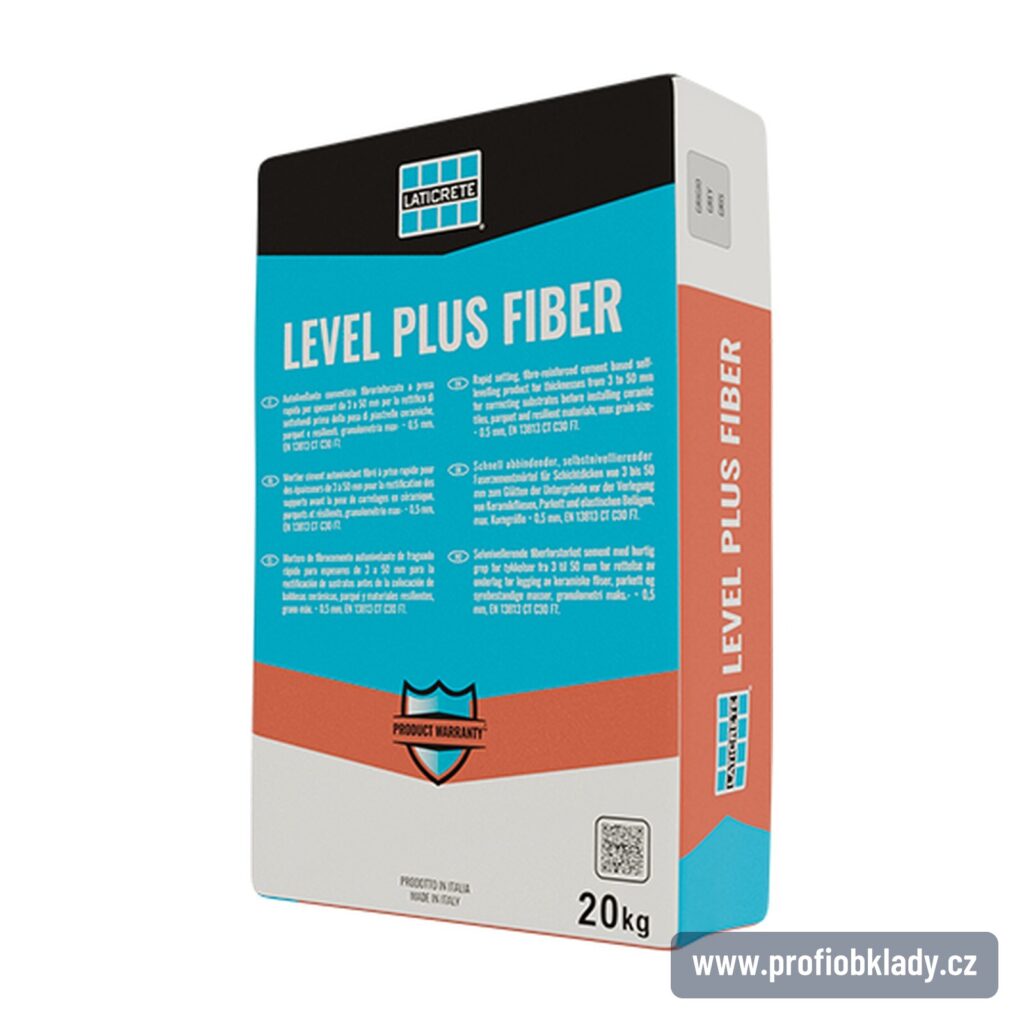
Fibre-reinforced self-levelling cement screed CT C30 F7 A1fl LATICRETE LEVEL PLUS FIBER 20 kg
Price for 1 pallet (54 pcs) 17 884.80 Kč (715.39 €) excl. VAT 21 640.61 Kč (865.62 €) incl. VAT
In stock at an external supplier, delivery within 15 working days depending on availability at the supplier
Free shipping from 5 000 Kč (200 €) excl. VAT, payment by cash on delivery or by invoice
If you need a different quantity, please call +420 737 246 887 to clarify the details of your order.
- For interior and exterior use
- Easy to use and fast setting – walkable after 4 hours
- Pumpable – no grinding or smoothing needed
- Flexible – polymer-modified
- Sold by full pallets only
- Pack: 20 kg
Prices and packaging
Sold by full pallets only. The table shows the price per piece and per full pallet. Prices exclude VAT. Minimum order 1 pallet (at least 10 000 Kč excl. VAT).
| Pallet | Pack | Price per piece | Price per pallet |
|---|---|---|---|
| 54 pcs | 20 kg | 331,20 Kč | 17 884,80 Kč |
Prices are excl. VAT.
Description
Fibre-reinforced self-levelling cement screed for layers 3–50 mm, interior and exterior, suitable for wooden substrates and underfloor heating, walkable after 4 hours. 20 kg bag.
LEVEL PLUS FIBER is an easy-to-use cement-based self-levelling compound designed for use on various substrates, including concrete and ceramic tiles. Thanks to its fibre reinforcement, it is also suitable for wooden substrates. It conforms to EN 13813 CT C30 F7 A1fl.
It is suitable for smoothing and levelling substrates by 3 to 50 mm, both indoors and outdoors. It is highly durable and provides a smooth, level surface for laying floor coverings. It is pumpable, so no grinding or smoothing is needed.
Use:
- To create a level, sound-insulating and high-strength layer for laying resilient floor coverings, flexible materials, wood, resin, ceramic or marble
- For interior and exterior use
- For layers 3 to 50 mm thick
- For residential and commercial use
- On laminated or plywood wooden boards
- Suitable for underfloor heating
- On old substrates with adhesive or levelling compound residues
- Ideal for levelling before laying large-format tiles
- Compatible with most adhesives
Features and benefits:
- For interior and exterior use
- Easy to use and fast setting – walkable after 4 hours
- Pumpable – no grinding or smoothing needed
- Flexible – polymer-modified
- Long gel times for better workability
- Surface suitable for most floor coverings
- Compatible with most adhesives
- Low emissions of volatile organic compounds (VOC)
- High yield
- CAM compliant
Specifications
| Manufacturer | LATICRETE |
|---|---|
| Standard | EN 13813: CT C30 F7 A1fl |
| Reaction to fire (EN 13501-1) | A1fl |
| Composition | cement, aggregate, fibres, additives |
| Colour | grey |
| Bulk density | ~ 1300 kg/m³ |
| Density after 28 days | ~ 1800 kg/m³ |
| Maximum grain size | 0.5 mm |
| Flammability | no |
| Compressive strength (24 h) | ~ 14 N/mm² (EN 13892-2) |
| Compressive strength (7 days) | ~ 28 N/mm² (EN 13892-2) |
| Compressive strength (28 days) | ~ 35 N/mm² (EN 13892-2) |
| Flexural strength (24 h) | ~ 3 N/mm² (EN 13892-2) |
| Flexural strength (7 days) | ~ 7 N/mm² (EN 13892-2) |
| Flexural strength (28 days) | ~ 7 N/mm² (EN 13892-2) |
| Tensile adhesion to concrete | ~ 1.5 N/mm² (EN 13892-8) |
| Shrinkage | ~ 0.3 mm/m (EN 13454-2) |
| Thermal conductivity λ | 1.35 W/mK (EN 12664) |
| Temperature resistance | from -30 °C to +90 °C () |
| Mix consistency | fluid |
| Bulk density of the mix | ~ 1900 kg/m³ |
| Mixing ratio | 22 %–24 % (4.4 l – 4.8 l of water per 20 kg bag) |
| Working time | ~ 20 minutes |
| Maximum thickness | ~ 50 mm |
| Minimum thickness | ~ 3 mm |
| Walkable after | ~ 4 hours |
| Waiting time before laying tiles | ~ 24 hours |
| Waiting time before laying stone or marble | ~ 48 hours |
| Waiting time before laying wood or resilient floor coverings | ~ 72 hours |
| Final curing | ~ 7 days |
| Application temperatures | from +5 °C to +30 °C |
| Consumption | 1.65 kg/m² per 1 mm of layer thickness |
| Emissions | GEV EMICODE EC1 Plus; indoor air emissions A+; compliant with CAM |
| Substrates | Concrete, screeds or mortar beds, outdoor wooden boards, TERRAZZO-type concrete floors, old tiles and stone |
| Residual moisture: Ceramic tiles | < 6 %, waiting time 24 hours |
| Residual moisture: Stone and marble | < 3 %, waiting time < 6 mm: 24 hours, > 6 mm: 48 hours |
| Residual moisture: Resin, resilient floor coverings and wood | < 2 %, waiting time < 6 mm: 24 hours, > 6 mm: 72 hours |
| Product numbers (manufacturer) | L0000000000011020 |
| Warranties | 1-year product warranty; 5–10–15-year system warranty |
| Availability by country | Czech Republic, Slovakia and other European countries (full list on the manufacturer's website) |
| Pack | 20 kg bag, 54 bags per pallet |
Technical information
Substrate preparation
- Substrates must be sound, level, cohesive and free of loose particles, dust, grease, paint, wax, rust or efflorescence. Remove laitance from freshly cast concrete. Screeds and concrete must be properly cured; at least 30 days for screeds and 3 months for concrete.
- Old ceramic floors must be degreased and lightly sanded to roughen the surface.
- Before applying LEVEL PLUS FIBER, the curing of the substrate must be checked with a carbide moisture meter; this prevents further deformation of the screed caused by shrinkage. The air and substrate temperature must not fall below +5 °C during application and for one week afterwards.
- To assess the residual moisture for the floor covering, the moisture must be measured with a carbide moisture meter. The values must not exceed these limits:
- Cement screeds: 2.0 % CM
- Anhydrite screeds without underfloor heating: 0.5 % CM
- Anhydrite screeds with underfloor heating: 0.3 % CM
- Wooden substrates must be clean, dry and able to bear the load. Repair damaged areas. Secure loose or poorly fixed boards with suitable screws. It is advisable to lay the boards with staggered joints, screwed down and glued.
Procedure
- Apply PRIMER SUPERIOR primer to the substrate and let it dry. Pour 4.4–4.8 litres of water into the mixing container. Add 20 kg of LEVEL PLUS FIBER and mix to a smooth, lump-free mixture. During mixing, the product sticking to the walls of the container can be scraped off with a spatula so that the material is worked in again and proper mixing is ensured. A mixer running at 500–700 rpm is recommended.
- Pour LEVEL PLUS FIBER onto the primed substrate and spread it evenly with a suitable tool within the stated working time. Placing levelling markers while the surface is still soft has proved very useful for checking the exact required height. The required layer thickness can be applied in a single layer. The fresh mortar must be de-aerated with a notched trowel, which promotes self-levelling. This method significantly improves the surface and the levelling. While it cures, protect LEVEL PLUS FIBER from excessive drying caused by high room temperature, direct sunlight or dry air. The room and floor temperature must be kept above +5 °C during application and for one week afterwards.
- Always follow the instructions of the manufacturer of the final floor covering regarding installation, surface preparation, moisture conditions and compatibility. Always test the suitability of the performance and the compatibility of the chosen covering systems before application. It is always advisable to make a small test area directly on site before proceeding with the finished floor for the intended use. The table below gives residual moisture levels depending on the covering applied:
- Lower temperatures, higher relative humidity, poor ventilation and a thicker layer of self-levelling compound will prolong the drying time of the self-levelling compound.
Limitations
- Absorbent surfaces adversely affect the self-levelling ability of the mortar, so the surface must be cleaned and primed with PRIMER PLUS or PRIMER SUPERIOR.
- Non-absorbent substrates, such as tiles, marble or Terrazzo-type floors, must be primed with PRIMER SUPERIOR before application.
- DO NOT APPLY to concrete younger than 3 months.
- The self-levelling compound must be completely dry before the floor covering is laid. It is recommended to measure the residual moisture with a carbide moisture meter.
- Ventilation is required around the work area; during curing, avoid draughts and excessive sunlight.
- The room and floor temperature must be kept above +5 °C during application and for one week afterwards. Dehumidifiers must not be used during the first 3 days of curing.
- If drying is too rapid (in heated rooms or due to direct sunlight), the surface of the layer may crack or split.
- Excess mixing water causes the components of the product to separate, which reduces strength. Areas with reduced strength must be removed mechanically.
- Existing structural and expansion joints must be respected by interrupting the poured surface with suitable separators.
- Rough and porous surfaces lead to higher material consumption.
- High temperatures shorten the setting time, low temperatures prolong it.
- Use only water and clean tools.
- Product that has already started to set must not be reactivated by adding water or fresh product. Insufficient strength development may result.
- The product must be protected from water and frost until it has fully cured. In bad weather this can take several days.
- Protect from rain for at least 48–72 hours after application.
- Avoid contact with skin and eyes. In case of irritation, wash thoroughly with clean fresh water. In case of eye contact, seek medical attention immediately.
- In areas with high humidity and poor ventilation, the drying time of the applied product may be prolonged.
- Keep out of the reach of children.
- For more information, see the product safety data sheet.
Cleaning tools
Use only water and clean tools.
Storage
Twelve (12) months in the unopened original packaging, stored off the ground in a cool, dry place. High humidity shortens the shelf life of bagged product.
More products