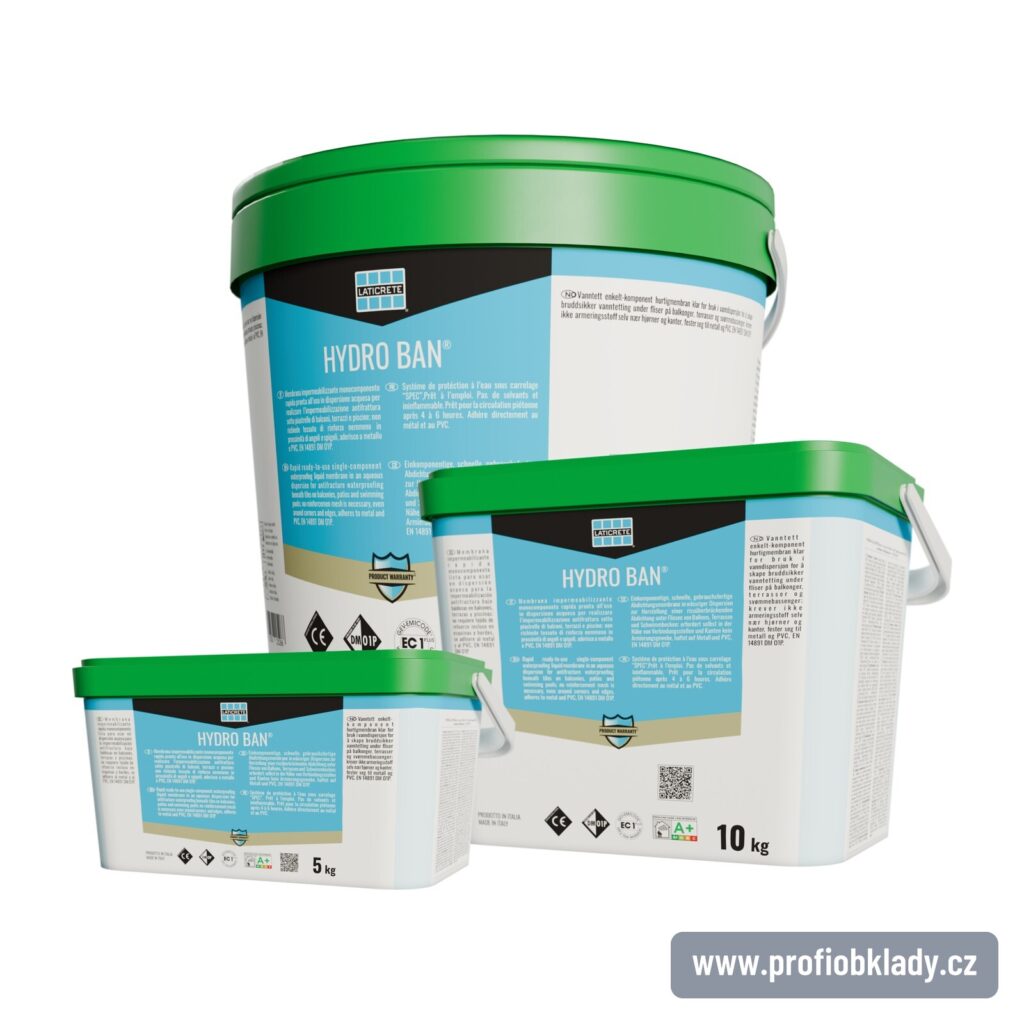
Liquid waterproofing membrane EN 14891 DM OP LATICRETE HYDRO BAN 5 kg, 10 kg, 20 kg
Price for 1 pallet (20 pcs) 16 560 Kč (662.40 €) excl. VAT 20 037.60 Kč (801.50 €) incl. VAT
In stock at an external supplier, delivery within 15 working days depending on availability at the supplier
Free shipping from 5 000 Kč (200 €) excl. VAT, payment by cash on delivery or by invoice
If you need a different quantity, please call +420 737 246 887 to clarify the details of your order.
- For interior, exterior and permanent immersion – ideal for waterproofing wet rooms and swimming pools
- Tiles, thin brick slips and stone can be fixed directly onto the HYDRO BAN membrane
- One-component and ready to use – easy and fast application with a brush or roller
- Thin; only 0.5–0.8 mm after curing
- Pack: 10 kg, 5 kg
Prices and packaging
Sold by the piece from 20 pcs, further pieces can be added one at a time. Prices exclude VAT. Minimum order 20 pieces (at least 10 000 Kč excl. VAT).
| Pack | Price per piece |
|---|---|
| 5 kg | 828,00 Kč |
| 10 kg | 1 548,00 Kč |
| 20 kg | 3 240,00 Kč |
Prices are excl. VAT.
Description
One-component liquid waterproofing without reinforcing fabric, with anti-crack protection, for showers, bathrooms, balconies, terraces and swimming pools under tiles, DM OP according to EN 14891. 5, 10 and 20 kg bucket.
HYDRO BAN is a thin, load-bearing waterproofing and anti-crack membrane that requires no fabric on flat areas, in corners or at edges. It is a one-component self-curing liquid rubber polymer that forms a flexible seamless waterproofing membrane and bonds directly to a wide range of substrates.
It is suitable for interior and exterior use and ideal for wet and permanently submerged applications, such as waterproofing wet rooms, showers and swimming pools. It is equipped with Microban® antimicrobial technology to protect the treated item and meets EN 14891 DM OP.
Use:
- Interior and exterior
- Swimming pools, fountains and water features
- Shower trays, shower enclosures and bath surrounds
- Industrial, commercial and residential bathrooms and laundries
- Spas and whirlpools
- Kitchens and food-processing areas
- Terraces and balconies above unoccupied spaces
- Worktops and facades
- Steam rooms (when used with a vapour barrier)
Features and benefits:
- For interior, exterior and permanent immersion – ideal for waterproofing wet rooms and swimming pools
- Tiles, thin brick slips and stone can be fixed directly onto the HYDRO BAN membrane
- One-component and ready to use – easy and fast application with a brush or roller
- Thin; only 0.5–0.8 mm after curing
- Bridges cracks up to 3 mm over shrinkage and other non-structural cracks
- No fabric needed (for joints or cracks with horizontal movement up to 3 mm)
- Bonds directly to metal and PVC installation fittings
- Dries quickly – flood test approx. 2 hours after final cure (at 21 °C / 50% relative humidity)
- Changes colour from light sage to olive green as it cures – the lighter colour makes inspection easier
- Safe – solvent-free and non-flammable
- Equipped with Microban® antimicrobial technology to protect the treated product
- Meets EN 14891 DM OP
- Exceeds ANSI A118.10 and A118.12
- IAPMO approved
- Rating “Extra Heavy Service” according to the TCNA performance levels (per ASTM C627 Robinson Floor Test)
Specifications
| Manufacturer | LATICRETE |
|---|---|
| Standard | EN 14891, DM OP |
| Classification according to EN 14891 | DM OP |
| Base | self-curing liquid rubber polymer |
| Colour | light green |
| Bulk density | 1.35 g/cm³ |
| Flammability | no |
| Temperature resistance | from -30 °C to +140 °C |
| Initial adhesion | ~ 1.0 N/mm² (requirement ≥ 0.5 N/mm²) |
| Adhesion after water immersion | ~ 0.8 N/mm² (requirement ≥ 0.5 N/mm²) |
| Adhesion after exposure to heat | ~ 1.3 N/mm² (requirement ≥ 0.5 N/mm²) |
| Adhesion after freeze-thaw cycles | ~ 0.9 N/mm² (requirement ≥ 0.5 N/mm²) |
| Adhesion after immersion in lime-saturated water | ~ 1.2 N/mm² (requirement ≥ 0.5 N/mm²) |
| Adhesion after immersion in coloured water | ~ 0.8 N/mm² (requirement ≥ 0.5 N/mm²) |
| Watertightness at 1.5 bar for 7 days (standard pressure) | no leakage (requirement: no leakage) |
| Crack-bridging ability (under standard conditions) | ~ 5.0 mm (requirement ≥ 0.75 mm) |
| Consistency | smooth, thick liquid |
| Density of fresh mix | 1.35 g/cm³ |
| Mixing ratio | ready to use |
| Application temperature | +10 °C to +30 °C |
| Average time to applying the second coat | ~ 1–2 hours |
| Time to flood test | 2 hours (after the last coat)* |
| Time to tile laying | 2 hours (after the last coat)* |
| Maximum thickness of a single coat | 0.4 – 0.6 mm |
| Maximum total thickness (dry) | 0.5 – 0.8 mm |
| Drying time: Concrete | 50 minutes |
| Drying time: Cement board | 30 minutes |
| Drying time: Fibre cement backer board | 15 minutes |
| Consumption | ~ 0.95 kg/m² (for two coats) |
| Substrates | Concrete, cement mortar, cement plaster, CMU (concrete masonry units), brick, plasterboard, exterior-grade plywood bonded with waterproof glue (interior only), cement fibre board, ceramic tiles and stone, cement terrazzo |
| Emissions | GEV EMICODE EC1 Plus; indoor air emissions A+; UL GREENGUARD (UL 2818) |
| Product numbers (manufacturer) | L0000000000007042, L0000000000007043, L0000000000007044 |
| Warranties | 1-year product warranty; 10-year system warranty; 10-year swimming pool system warranty |
| Availability by country | Czech Republic, Slovakia and other European countries (full list on the manufacturer's website) |
| Pack | 5 kg pail (80 pails per pallet), 10 kg (48 pails per pallet), 20 kg (27 pails per pallet) |
Technical information
Substrate preparation
- The surface temperature must be between 10 and 30 °C during application and for 24 hours afterwards. All substrates must be structurally sound, clean and free of dirt, oil, grease, paint, laitance, efflorescence, concrete sealers or curing compounds. Smooth rough or uneven concrete with LATICRETE mortar to a surface equal to a wood-float finish or better. Do not level gypsum- or asphalt-based products.
- The maximum deviation in flatness must not exceed 6 mm in 3 m, with a maximum of 1.5 mm in 0.3 m between high spots. Dampen hot, dry surfaces and sweep off excess water – application can be made on a damp surface. For application on concrete, see DS 663.5.
- 1. Substrates must be structurally sound, stable and sufficiently rigid to support ceramic tile/stone tile, thin brick veneers and similar finishes. The installer must verify that the deflection of interior plywood floors under all live, dead and impact loads does not exceed the industry standards L/360 for ceramic tile and brick or L/480 for stone tile and L/600 for all exterior tile applications, where L = span.
- 2. Minimum construction of interior plywood floors.
- a) SUBFLOOR: 15 mm thick exterior-glue plywood, either square-edge with all panel edges supported, or tongue-and-groove, over joists at a maximum of 400 mm on centre; fasten the plywood every 150 mm along panel ends and every 200 mm along intermediate supports with 8d ring-shank, coated or hot-dip galvanised nails (or screws); leave 3 mm between panel ends and 6 mm between panel edges; all panel ends must be supported by a structural member; glue the panels to the joists with construction adhesive.
- b) FLOOR UNDERLAYMENT: 15 mm thick exterior-glue plywood, fastened every 150 mm along panel ends and every 200 mm in the panel field (both directions) with 8d ring-shank, coated or hot-dip galvanised nails (or screws); leave 3 mm to 6 mm between panels and 6 mm between panel edges and adjacent surfaces; offset underlayment joints from subfloor joints and stagger joints between panel ends; glue the underlayment to the subfloor with construction adhesive. For full details see technical data sheet 152 (Installing ceramic tile, stone or brick on wood floors).
- Fill all cracks in the substrate, cold joints and control joints flush with latex-modified LATICRETE thin-set mortar. Apply a generous coat** of HYDRO BAN about 200 mm wide over substrate cracks, cold joints and control joints with a brush or roller (heavy-nap roller). A 150 mm waterproofing / anti-fracture fabric can be used with HYDRO BAN to pre-treat cracks, joints, arches, corners, drains and penetrations.
- Fill all substrate corners and floor/wall transitions and changes of plane flush with latex-modified thin-set mortar. Apply a generous coat** of HYDRO BAN about 200 mm wide over substrate corners and floor/wall transitions with a brush or roller (heavy-nap roller).
- Drains must be of the type with a bonding flange or clamping ring, with weep holes and in accordance with ASME A112.6.3. Apply a generous coat** of HYDRO BAN liquid waterproofing membrane around and over the bonding flange or the lower half of the drain clamping ring. Cover with a second coat** of HYDRO BAN. After it dries, apply a bead of LATASIL™ silicone sealant where HYDRO BAN meets the drain neck. Fit the upper half of the drain clamping ring.
- Leave a gap of at least 3 mm between drains, pipes, fixtures or other penetrations and the surrounding ceramic tile, stone or brick. Fill any gaps around pipes, fixtures or other penetrations with latex-modified thin-set mortar. Apply a generous coat** of liquid HYDRO BAN around the penetration opening. Cover with a second coat** of HYDRO BAN. Bring HYDRO BAN up to the level of the tile or stone. After it dries, seal the perimeter with LATASIL silicone sealant. When waterproofing swimming pools, it is essential to use accessories with flanges.
Procedure
- HYDRO BAN® can be applied with a brush, roller or masonry trowel. All areas must have two (2) coats to ensure waterproofing performance. When applied with a paint roller at 0.5 – 0.8 mm dry membrane, the substrate will not show through the HYDRO BAN. The colour changes from light sage green to olive green when fully cured. Before using the product, read the full installation instructions in DS 663.5.
- Crack isolation (partial coverage): crack suppression must be carried out over at least three times the width of the tile or stone being installed. Tile laid over the crack must not touch the concrete. Apply a liberal coat** of HYDRO BAN at least three times the tile width with a roller or brush and allow to dry. Once the first coat is dry to the touch, apply a second liberal coat** of HYDRO BAN over the first. Alternatively: apply a liberal coat** of liquid HYDRO BAN three times the tile width over the crack with a roller or brush and immediately embed a 150 mm wide waterproofing / anti-fracture fabric into the wet liquid over the crack. Press firmly with a brush or roller so that the liquid fully penetrates (bleed through). Immediately apply another liberal coat** of liquid HYDRO BAN over the fabric and allow to dry. Once the first treatment is dry, apply a liberal coat** of HYDRO BAN over the first wide coat with a roller or brush and allow to dry. Treat the joint nearest the crack, a saw cut or a cold joint in the tile or stone installation with LATASIL silicone sealant.
- Main application: Allow all pre-treated areas to dry to the touch. Apply a generous coat** of HYDRO BAN with a brush or roller over the substrate, including the pre-treated areas. Apply another generous coat** of HYDRO BAN over the first coat of HYDRO BAN. Allow the top coat to dry to the touch, approximately 1–2 hours at 21 °C and 50 % relative humidity. When the final coat is dry to the touch, inspect the final surface for pinholes, voids, thin spots or other defects. HYDRO BAN dries to the touch to an olive green colour. Use additional HYDRO BAN to seal any defects.
- Protection: Protect the newly applied membrane, even when covered with thin-set ceramic tile, stone or brick, from rain or other water for a minimum of 2 hours at 21 °C and 50 % relative humidity.
- Flood test: Allow the membrane to cure completely before flood testing, typically 2 hours after final cure at 21 °C and 50 % relative humidity. Longer curing times will be required in cool and/or humid conditions. At temperatures of 10 – 21 °C, allow 24 hours after final cure before flood testing.
- Installing final surfaces: Once HYDRO BAN is dry to the touch, ceramic tile, stone or brick can be installed by the thin-set method with LATICRETE latex thin-set mortar. Allow HYDRO BAN to cure for 2 hours at 21 °C and 50 % relative humidity before covering with a thick mortar bed, epoxy adhesives, terrazzo or moisture-sensitive resilient or wood floors. Do not use solvent-based adhesives directly on HYDRO BAN.
- Drains and penetrations: Use LATASIL silicone sealant and foam backer rod to seal the gap between the drain or penetration and the finished surface. Do not use grout or grout mortar.
- Control joints: Ceramic tile, stone and brick installations must include sealant-filled joints above all control joints in the substrate. However, sealant-filled joints may be offset horizontally by up to one tile width from the location of the control joint in the substrate to match the joint pattern.
- Expansion joints: Ceramic tile, stone and thin brick installations must include expansion joints at corners, angles, other changes of plane of the substrate and above all expansion joints in the substrate. Expansion joints in ceramic tile, stone or brick masonry are also required at perimeters, at restraining surfaces and at penetrations. Use LATASIL silicone sealant and foam backer rod.
- Spray application of HYDRO BAN®: Follow all installation and surface preparation requirements in this document and in DS 663.5 and TDS 410. The spray equipment used to apply HYDRO BAN® should be capable of producing a maximum of 22.8 MPa at a flow rate of 3.6 to 6.0 l/min using a 0.521 or 0.631 reversible tip. Keep the equipment filled with HYDRO BAN to ensure continuous liquid application. The hose length must not exceed 30 m and the diameter 9 mm. Apply a continuous film of HYDRO BAN with overlapping spray passes**. The wet film has a sage green appearance and dries to a darker olive green. When the first coat has dried to a uniform olive green colour, approximately 45 to 90 minutes at 21 °C, visually inspect the coating for voids or pinholes. Fill any defects with additional material and apply a second coat** perpendicular to the first. Check the wet film thickness regularly with a wet film thickness gauge. Each wet coat should be 0.4 – 0.6 mm thick. The combined dry coating should be 0.5 – 0.8 mm thick. Continuously check the coating thickness with a wet film thickness gauge while dispensing HYDRO BAN to ensure the proper thickness and coverage are achieved. Rebound and overspray will consume more product. To achieve the required film thickness, the coating must be free of pinholes and air bubbles. Do not back-roll the sprayed coating. Allow HYDRO BAN to cure according to the instructions in this document, in DS 663.5 and TDS 410 before installing tile or stone. It is important to note that areas that are not to be coated with HYDRO BAN should be masked off with tape and protected from possible overspray. Expansion and movement joints must be respected and treated according to the instructions in this document, in DS 663.5 and TDS 410.
Limitations
- DO NOT BOND to OSB, particleboard, interior-glue plywood, luan, Masonite® or hardwood surfaces.
- DO NOT USE over dynamic expansion joints, structural cracks or cracks with differential vertical movement (see the HYDRO BAN installation instructions, DS 663.5, for full instructions).
- Waterproofing membranes in permanently submerged applications must be installed so as to create a continuous watertight tank effect without voids or breaks. It is therefore not recommended to install waterproofing membranes over limited areas (e.g. only at the water line) in submerged applications.
- DO NOT apply over structural cracks, cracks with vertical movement or cracks with horizontal movement > 3 mm.
- DO NOT USE as a vapour barrier (especially in steam rooms).
- DO NOT EXPOSE the unprotected membrane to sun or weather for more than 30 days.
- DO NOT EXPOSE to negative hydrostatic pressure, excessive vapour transmission, rubber solvents or ketones.
- Must be covered with ceramic tile, stone, brick, a compacted dry-pack mortar bed (non-immersion applications), terrazzo or another load-bearing finish. For temporary covering, use a protection board.
- Before using the product in shower pan applications, obtain approval from the local building authority.
- DO NOT INSTALL directly over single-layer wood floors, plywood tubs/showers/fountains or similar structures.
- DO NOT USE under cement or other plaster finishes. If a waterproofing membrane is required under plaster finishes, consult the plaster manufacturer for their recommendations.
- DO NOT USE under self-levelling flooring compounds or decorative wear-resistant surfaces. Note: Substrates must be structurally sound, stable and sufficiently rigid to support ceramic tile/stone tile, thin brick veneers and similar finishes.
- For further safety information, see the safety data sheet (SDS).
- Before applying to the whole area, carry out a small test of the product.
- Allow the membrane to cure completely (typically 24 hours at 10 °C–21 °C and 70 % relative humidity); before installing tile or stone, carry out a flood test (typically 2 hours at 21 °C or higher and 50 % relative humidity before the flood test).
- The maximum moisture content of the concrete substrate must not exceed 3 %.
- In cold weather, protect the finished work from traffic until fully cured.
- The wet coat thickness is 0.4 to 0.6 mm per coat. Use a wet film thickness gauge to check the thickness.
- Allow damp mortars to cure for 72 hours at 21 °C before applying HYDRO BAN. Under these conditions, allow HYDRO BAN to cure for at least 2 hours at 21 °C before the flood test.
- Protect from traffic and water until fully cured.
- HYDRO BAN changes from light sage green to a darker olive green when fully cured. The second coat must not be applied until the first coat has fully cured. All flood test times are counted from the moment the second coat is fully cured and no light sage areas are visible.
- After applying the second coat at 21 °C and 50 % relative humidity, the time before tile installation varies depending on the substrate, temperature and relative humidity.
- On highly absorbent substrates, it may be necessary to pre-treat the substrate with PRIMER PLUS, PRIMER SUPERIOR or a HYDRO BAN primer coat consisting of 1 part HYDRO BAN and 4 parts clean water.
- HYDRO BAN has no hazard classification under Directive 99/45/EC.
- Keep out of the reach of children.
- In case of contact with eyes and skin, wash with plenty of water.
Storage
Unopened original packages of the product are guaranteed to be in first-quality condition for two (2) years when stored off the ground in a dry place.
More products